
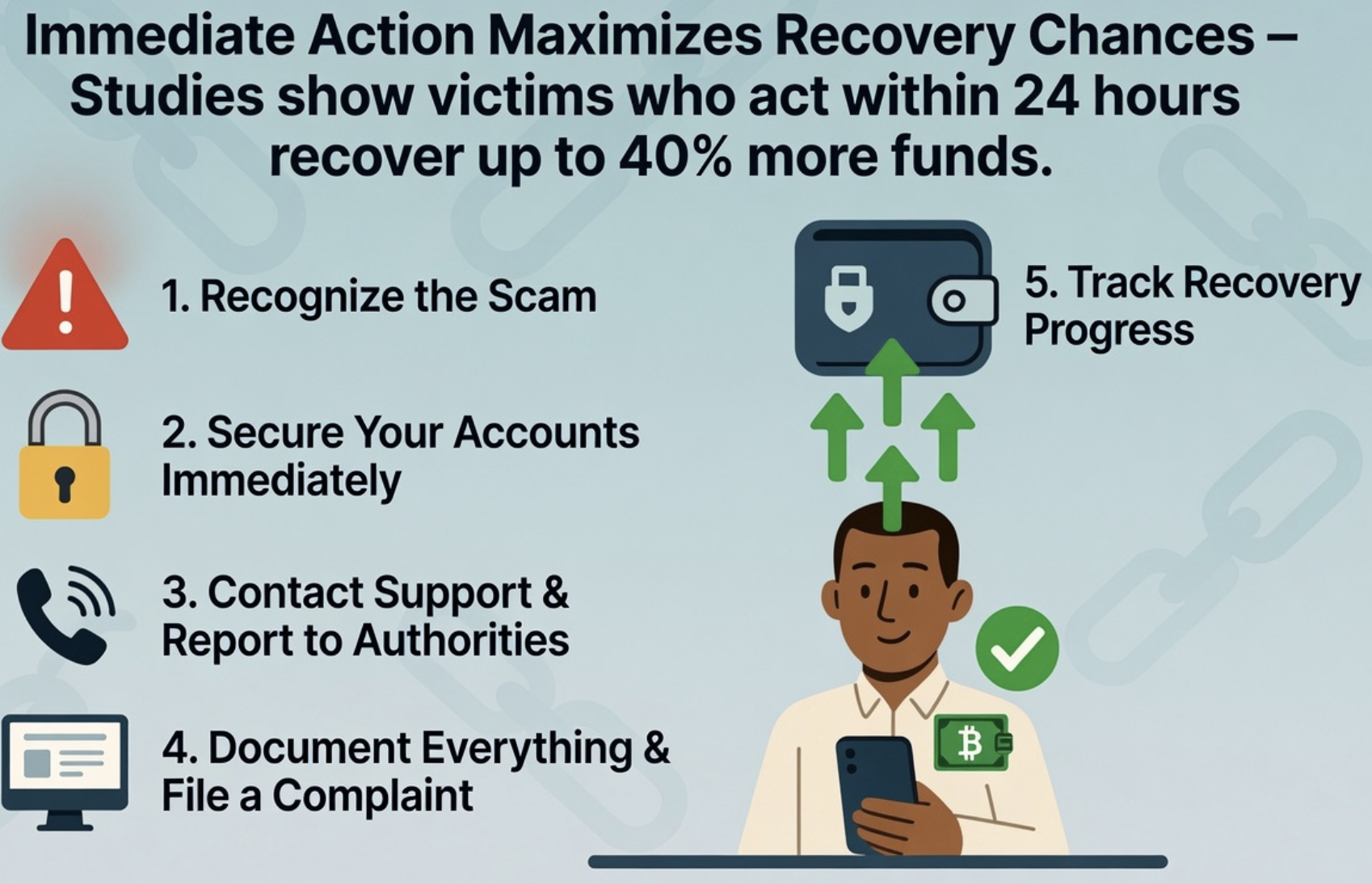
Crypto Scam Recovery: What Victims Should Do Immediately
Cryptocurrency scams continue to affect thousands of investors every year, costing victims billions of dollars globally. Fraudsters have become increasingly sophisticated, using fake investment platforms, phishing websites, wallet-draining smart contracts, romance scams, impersonation schemes, and fraudulent crypto exchanges to steal digital assets. Once cryptocurrency is transferred to a scammer, transactions are generally irreversible, making it essential to act quickly and strategically.
If you’ve recently lost Bitcoin, Ethereum, USDT, Solana, or any other cryptocurrency to a scam, don’t panic—but don’t delay either. The actions you take during the first few hours and days can help preserve valuable evidence, protect any remaining assets, and support future investigations.
This comprehensive crypto scam recovery guide explains exactly what victims should do immediately after discovering they’ve been scammed.
Recognize the Scam and Stop Sending Additional Money
One of the biggest mistakes victims make is continuing to send cryptocurrency after realizing something is wrong.
Scammers are skilled manipulators who often convince victims that they only need to make “one final payment” before their funds can be released. These requests may be disguised as:
- Withdrawal fees
- Government taxes
- Anti-money laundering (AML) verification charges
- Liquidity fees
- Wallet synchronization fees
- Security deposits
- Insurance payments
- VIP membership upgrades
- Account activation fees
These are common advance-fee fraud tactics. Every payment simply increases the victim’s losses while giving the scammer another opportunity to disappear.
If anyone claims your cryptocurrency is locked until you pay another fee, stop all payments immediately. Legitimate cryptocurrency exchanges generally deduct applicable fees from your account balance rather than requiring new deposits to unlock withdrawals.
Secure Your Wallets and Exchange Accounts
If you’ve connected your wallet to a suspicious website or approved unknown smart contracts, act quickly to protect any remaining funds.
Start by:
- Changing passwords for all cryptocurrency-related accounts.
- Enabling two-factor authentication (2FA) where available.
- Disconnecting unknown decentralized applications (DApps).
- Revoking unnecessary token approvals and smart contract permissions.
- Moving any remaining assets to a newly created wallet if you believe your current wallet has been compromised.
- Updating passwords for the email account associated with your crypto accounts.
If the scam involves a WalletConnect phishing attack or malicious decentralized application, leaving your wallet connected could expose any remaining assets to additional theft.
Save Every Conversation and Piece of Evidence
Evidence is one of the most valuable assets after a cryptocurrency scam.
Before deleting anything, collect and organize:
- Emails
- WhatsApp conversations
- Telegram chats
- Discord messages
- SMS messages
- Screenshots of investment dashboards
- Deposit confirmations
- Website URLs
- Usernames
- Phone numbers
- Social media profiles
- Transaction confirmations
- Login history
- Advertising materials
Even conversations that appear insignificant may later help establish timelines or identify additional victims connected to the same operation.
Store multiple backups of this information in a secure location.
Export Your Wallet History
Most cryptocurrency wallets allow users to review and export transaction history.
Be sure to record:
- Wallet addresses
- Transaction IDs (TXIDs)
- Dates and times
- Token types
- Transaction amounts
- Network used (Ethereum, Bitcoin, BNB Chain, Solana, Tron, etc.)
- Receiving wallet addresses
Blockchain transactions are permanent. Even though they cannot usually be reversed, transaction histories can help investigators trace the movement of stolen assets across multiple wallets.
Never rely solely on screenshots. Whenever possible, save the actual transaction hashes from blockchain explorers.
Review Blockchain Activity
Public blockchains allow anyone to verify transactions.
By examining your wallet history, you may discover:
- Where your funds were sent
- Whether assets were converted into different cryptocurrencies
- Whether funds were split across multiple wallets
- Whether the destination wallet has been associated with previous scams
- Whether the assets eventually reached a centralized exchange
This information may become useful if exchanges or authorities later request supporting documentation.
Contact Cryptocurrency Exchanges
If blockchain records indicate that stolen cryptocurrency was transferred to a centralized exchange, notify that exchange immediately.
When contacting an exchange, include:
- Transaction hashes
- Wallet addresses
- Screenshots
- Timeline of events
- Copies of communications with the scammer
- Any identifying information you possess
While exchanges cannot simply reverse blockchain transactions, they may preserve account records or cooperate with lawful investigations where appropriate.
The sooner you notify the exchange, the greater the possibility that relevant account information may still be available if authorities later become involved.
Report the Scam
Many victims never report cryptocurrency scams because they believe nothing can be done.
However, reporting serves several important purposes:
- It helps authorities identify organized fraud networks.
- It contributes to consumer protection efforts.
- It may connect your case with other victims.
- It creates an official record of the incident.
- It may support future investigations or legal proceedings.
Depending on your country, you may report cryptocurrency fraud to law enforcement, financial regulators, consumer protection agencies, or cybercrime reporting centers.
If the scam originated through Facebook, Instagram, WhatsApp, Telegram, X, or another online platform, report the fraudulent account there as well.
How RadleyAssist.com Supports Scam Victims
If you’ve lost cryptocurrency to an online scam, RadleyAssist.com provides educational resources and guidance to help victims organize evidence, understand blockchain transaction histories, and navigate the reporting process.
Depending on the circumstances, this may include:
- Reviewing transaction information.
- Assisting with blockchain tracing.
- Organizing supporting documentation.
- Helping victims prepare evidence for reporting to relevant organizations.
- Providing information about common cryptocurrency scam tactics.
Because every case is different, outcomes vary, and no service can legitimately guarantee the recovery of stolen cryptocurrency.
How to Reduce the Risk of Future Crypto Scams
While no investment is entirely risk-free, following these practices can significantly reduce your exposure to fraud:
- Research every platform before investing.
- Verify licensing or regulatory claims where applicable.
- Avoid guaranteed returns.
- Never share your wallet’s recovery phrase or private keys.
- Use hardware wallets for large cryptocurrency holdings.
- Enable two-factor authentication.
- Double-check website URLs before connecting your wallet.
- Be cautious of unsolicited investment opportunities on social media.
- Never rush into investments because of pressure or limited-time offers.
Final Thoughts
Becoming the victim of a cryptocurrency scam can be financially and emotionally overwhelming. While recovering stolen cryptocurrency is often difficult, taking immediate, well-informed action can help protect any remaining assets, preserve critical evidence, and support future investigations.
If you’ve experienced a crypto scam, stop sending additional funds, secure your accounts, document everything, report the incident promptly, and remain cautious of anyone promising guaranteed recovery. Acting quickly—and staying informed—can make a meaningful difference in the aftermath of a scam.